For quantity surveyors, buyers and main contractors, bespoke joinery can be one of the harder packages to pin down on cost. Unlike off-the-shelf products, every bespoke joinery item is designed and made for a specific project, so pricing depends on the detail. This guide explains how commercial joinery is specified and costed, what really drives the price, and how off-site manufacture can bring more certainty to both budget and programme.
Key takeaways
- Bespoke joinery is priced from drawings and specifications, not a fixed catalogue.
- The main cost drivers are design complexity, materials and finishes, quantity and compliance.
- Clear, approved drawings lead to more accurate pricing and fewer variations.
- Off-site manufacture supports both cost and programme certainty.
How bespoke joinery is specified
Bespoke joinery starts with the design intent — an architect’s drawings, an interior designer’s specification or a contractor’s requirements. From there it’s developed into manufacturing drawings that define dimensions, materials, finishes, fixings and any performance requirements. The more complete and approved this information is, the more accurately the work can be priced and made. Gaps or late changes are the most common cause of cost variations, so a clear specification benefits everyone involved.
What drives the cost of commercial joinery
Several factors determine the price of a bespoke joinery package. Understanding them helps explain why two projects of similar size can carry very different costs.
Design and complexity
Simple, repeatable items cost less per unit than intricate, one-off pieces. Curves, mixed materials, integrated services such as lighting or power, and detailed finishes all add to the cost.
Materials and finishes
The choice of timber, veneer, laminate, solid surface or paint finish has a significant effect — both in the material itself and the labour to apply it. Premium veneers and specialist finishes sit at the higher end.
Quantity and repetition
Quantity influences unit cost. A single bespoke reception desk carries all of its design and set-up cost alone, whereas fifty identical doorsets spread that cost and benefit from an efficient production run.
Compliance requirements
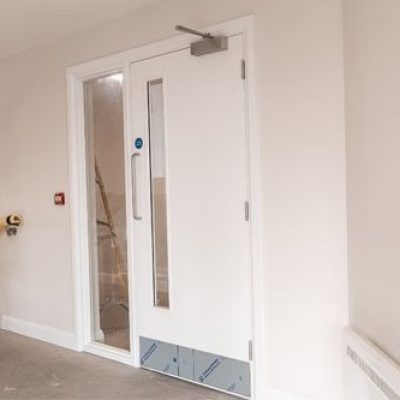
Where joinery must meet a performance standard — such as fire-rated doorsets or acoustic assemblies — testing, certification and controlled manufacture add cost, but they are essential to meet the specification.
Supply or supply-and-install
Whether the package is supply-only or supply-and-install, along with site access, sequencing and location, all feed into the final price.
How a joinery package is priced from drawings
A joinery manufacturer or estimator works from the drawings and specification to measure quantities and build up a price for each item — material, labour, finishing, fixings and, where relevant, installation. On larger projects this forms a joinery package that can be priced against a bill of quantities or a schedule. Accurate drawings and a settled specification are what make this pricing reliable: the clearer the information, the fewer assumptions and provisional sums are needed.
How off-site manufacture supports cost and programme certainty
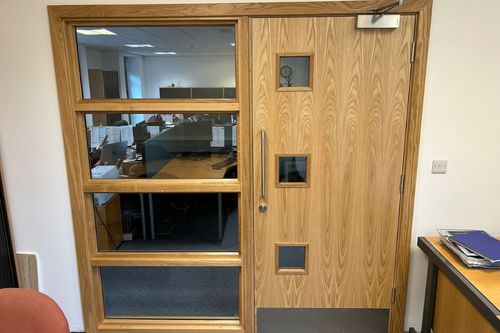
Manufacturing joinery off-site, in a controlled factory environment, helps remove some of the biggest sources of cost uncertainty. Producing complete units to approved drawings reduces on-site labour, waste and the risk of errors, and means installation is faster and more predictable. For a quantity surveyor or contractor, that translates into fewer variations, a tighter programme and greater confidence that the joinery will arrive right first time. It’s the same approach behind our internal timber doorsets and bespoke commercial joinery.
Working with a joinery manufacturer: what to provide
To get accurate pricing quickly, it helps to share as much of the following as possible:
- Architect or designer drawings and specifications
- Quantities and schedules where available
- Finish and material requirements
- Any performance or compliance requirements, such as a fire rating
- Programme dates, and whether the package is supply-only or supply-and-install
Frequently asked questions
How is bespoke joinery priced?
It’s priced from drawings and specifications. The manufacturer measures quantities and builds a price from materials, labour, finishing and installation, rather than using a fixed catalogue price.
Why does bespoke joinery cost more than off-the-shelf?
Each item is designed and made for a specific project, so it carries its own design, set-up and finishing cost. Repetition and clear specifications help bring the unit cost down.
Does fire-rated joinery cost more?
Generally yes. Testing, certification and controlled manufacture add cost, but they are essential where a fire performance standard must be met.
Talk to EYJ about your joinery package
EYJ manufactures bespoke commercial joinery and doorsets in our own East Yorkshire factory, supplied to main contractors and fit-out firms across the UK. If you’d like to understand where joinery sits in the build, read our guide to first fix vs second fix joinery, or get in touch to price a package.